
Helpful Recovery Exercises for Improved Mental Health (Part 2)

Children who grow up in a psycho-traumatic environment develop borderline behaviour patterns that are driven by fear, anger, and incredible sadness. As these children grow into young adults, they seek out ways of coping with their intensive and unstable feelings and behaviour. Some will turn to “pleasure” addictions such as alcohol, drugs, or sex and others will turn to “pain” addictions such as cutting, burning, or putting themselves at risk with reckless driving and so forth. Self-destructive behaviours damage, and eventually destroy, the good in their lives. In time, they are left alone and hurting in the Borderline Zone. Ultimately, “ugly” truth heals better than “soothing” denial. Use these recovery exercises as a basic guide to help yourself explore different patterns of maladaptive behaviour.
Recovery Exercise 4.1: The Maturity/Immaturity Paradox

The objective of this recovery exercise is to understand how maturity/immaturity paradox may be at work and gain insight into resolving this paradox.
Some people find themselves to be mature beyond their years in some ways, such as with regard to survival skills. These people may find themselves to be relatively naïve in many other ways, such as with regard to dealing with outside frustrations or their own anger. In the past, in what ways do you think you were mature or experienced beyond your years?

Today, in what ways do you see yourself as more mature or experienced than most people who are the same age as you? In the past, in what ways do you think you were relatively naïve in the ways of the world? Today, in what ways do you think you remain relatively naïve in the ways of the world?

Recovery Exercise 4.2: How Do You Spell Relief?

It helps to explore and understand the mechanism used to achieve a sense of relief, calm, or freedom from stress, worry, or pain. Relief of emotional and physical pain can be sought and achieved in many ways, some of the adaptive and some of them maladaptive. Discuss the ways that you have attempted to relieve emotional or physical pain in the past. In what ways do you think these attempts were mature or immature? Talking to another look at the situations that caused the stress or pain, in what ways do you think the pain could have been relieved more effectively?

Recovery Exercise 4.3: “When Things Are Too Good” or “Time to Self-Destruct”

The objective is to understand self-destructive mechanisms that may become active when things seem too good.

Some people seem to have a low tolerance for things going too well in their lives. Just when they seem to have met the right person, started the right job, or in some way begun a meaningful experience, they seem to sabotage the positivity and somehow replace it with negativity. Have you ever sabotaged something good in your life? How? Why? Is there a part of you that feels that you do not deserve to have good things happen to you? How did these feelings arise? What needs to happen in order for you to feel that you deserve good things to happen to you?

Recovery Exercise 4.4: Of Emptiness and Nothing

The objective is to understand how a void in one’s life may be filled in some maladaptive way.

Some people experience a gaping void or emptiness in their lives that they try to fill in some way. Have you ever experienced a void or emptiness in your life? How would you describe that void? How would you describe your attempts to fill that void? How stressed have you felt in your attempts to fill that void? What will it take to genuinely fill that void?

It is helpful to understand how feelings experienced in the hands of someone in the past may be replaced by others in the future. The same emotions and painful feelings I cause my significant other to feel, my parents made me feel years before.

Can you identify with the notion of experiencing some emotion or feeling at the hands of one person, only to have another person experience many of the same emotions or feelings as a result of your own actions? What memories does the experience of these emotions or feelings call up in you? Why might you have a conscious or unconscious need for others close to you experience these same emotions or feelings? Do you think it is possible for you to allow someone to get close to you without pushing him or her away?

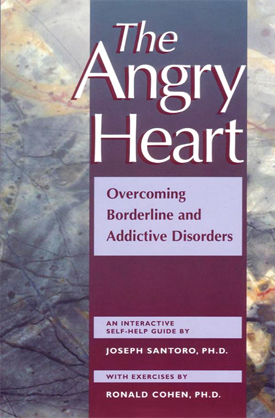
These recovery exercises are adapted from the book The Angry Heart written by Dr. Joseph Santoro and Dr. Ronald Cohen. Dr. Joseph Santoro is one of the founding members of Blue Sky Behavioral Health. Blue Sky offers individualized outpatient as well as residential treatment programs for mental health disorders such as borderline personality disorder treatment. Our supportive and licensed clinical staff can make a major difference in your life. Learn how to live life well by contacting our facility today. Call (888) 822-7348 or visit us online at https://blueskyrecovery.com/


Helpful Recovery Exercises for Improved Mental Health

Life can often feel full of confusion. Confusion about what to think, feel, and do. Confusion about where to turn for help. Confusion about what the future will throw at us next. However, by talking about the things that are bothering us we can learn to feel better without the use of drugs, alcohol, sex, or any other type of self-injurious addictive activity. Talking about what you really feel makes up the first, second, and third steps of recovery. The below recovery exercises can help you better understand the crucial role trust plays in your relationships and behaviors.

Recovery Exercise 3.1: In Whom Do You Trust?

The objective is to consider the role of trust in one’s life as well as well as the people who are, and are not, trusted.

Trust is the one and the same time belief, feeling, and ability. People come to trust other people as a result of relying on them, and seeing that this reliance had predicted and consistent payoffs. From early on in life, some children learn the hard lesson that they connote rely on their caregivers. Compounding this tragedy is the fact their ability to trust other people both in childhood and later in life may be severely affected.

How would you characterize the level of trust you place in other people? List the people you trust the most and discuss thy you trust them. List the people and kinds of people you trust least and discuss why you don’t trust them. What early childhood experiences do you think contributed to your present ability to trust others, as eel as your choice of who you trust?

Recovery Exercise 3.2: Relationships – Then and Now

The objective is to consider how early relationships with caregivers may influence current relationships with peers and lovers.

Early, dysfunctional relationships with caregivers and siblings may have lasting effects in terms of one’s ability to bond with friends or make lasting and loving attachments with others. What are some of your earliest memories relevant to your relationship with your caregivers?

What are some of the primary “events” in your relationship with your caregivers that led you to the relationship you have with them today (or if deceased, the relationship you had prior to their death)? How do you think aspects of this relationship might be affecting you today in terms of both your ability to make lasting friendships and your ability to enter into a loving and lasting attachment with another person?

Recovery Exercise 3.3: Declarations of Financial Independence

The objective is to consider the role of money in one’s life and the extent to which desire for it has been served in adaptive or maladaptive ways.

Independent living requires funds sufficient to maintain independence. There are many obvious and hidden costs related to common expenditures such as food, clothing, shelter, telephone, and recreational expenses. While many people, for example, adolescents, desire to be financially independent, they do not yet have the means to do so. Some people have the means for achieving independence, or have actually achieved it in the past but have somehow self-destructed along the way. In either case the likely result is criminal or other maladaptive behavior as a means of earning enough money to assert their financial independence.

What role does money, or lack of it, play in your own life? In what ways, legally as all as illegally, have you earned money in the past? How do you think you learned to use money the way that you use it? In what ways in the past would you describe your money-related behavior as maladaptive? How do you earn money? Are you proud of how you earn money? Why or why not?

Describe the satisfaction you experienced as a result of purchasing or owning physical possessions. What kind of things did you spend the most money on? What kind of things did you not spend enough on? In what ways do you hope that your money earning and spending behaviors will be more adaptive in the future? How do you anticipate your spending habits will change as your behavior becomes more adaptive?

Recovery Exercise 3.4: Part of Me

The objective is to get in touch with the sane, rational, and adaptive part or side of you that knows what is right.

There was a man Samuel who had a mental conflict with an irrational side of him that knew it was out of control, and a saner, more rational side striving to adaptively change what was happening. Many people report some similar phenomena in terms of a mental conflict between adaptive and maladaptive forces.

Draw a picture of the irrational side of yourself. Use as much creative energy as you can. Allow your imagination to roam free. When you have done this, write a brief, twenty-five-word description of your “dark” side. Next, draw a picture of your rational side. Be as creative and energized as you can be. Avoid being judgmental. When you have completed your drawing, describe in twenty-five words your “bright” side. How are your two drawings different from one another? How are they similar?

Recovery Exercise 3.5: Untwisting the Twister

The objective is to halt a maladaptive swirl of thoughts and beliefs.

In this article the term borderline twister will be used to describe a particular variety of maladaptive thinking. The borderline twister begins with the thought like, “I want to be accepted by you, but I can’t accept myself” and it spins into “I hate you for liking me because I hate me, but I blame you for how I feel” and ends with “I reject you, but please don’t reject me.”

Look at yourself in the mirror and make eye contact for as long as you can tolerate it. Then take out a picture of someone who cares about you. Look at that picture for a few minutes and try to imagine how that person feels about you. Now, compare and write about how you felt looking at yourself in the mirror and how you felt about looking at that person who cares about you. In what ways are those feelings similar and in what ways are they different.

Recovery Exercise 3.6: Getting with the Program

The objective is to feel comfortable considering some form of a treatment program.

For Samuel, even the word program was scary. He entered one treatment program and followed a coping strategy of pretending to be a “good boy.” When he eventually attempted to escape from that program that is, have more liberty and control of his own life- the consequence was confinement in a setting in which he actually had less liberty and control of his life. His life circumstances only really began to improve once he “got with the program.”

What are your resistances to entering a treatment program that may prepare you to better cope with all you are dealing with? What forces are operating in your life that might prompt you to pretend to be “good,” rather than making an earnest effort to improve? What rewards do you see for yourself at the successful completion of treatment program?

These recovery exercises are adapted from the book The Angry Heart written by Dr. Joseph Santoro and Dr. Ronald Cohen. Dr. Joseph Santoro is one of the founding members of Blue Sky Behavioral Health. Blue Sky offers individualized outpatient as well as residential treatment programs for mental health disorders such as borderline personality disorder. Our supportive and licensed clinical staff can make a major difference in your life. Learn how to live life well by contacting our facility today. Call (888) 822-7348 or visit us online at https://blueskyrecovery.com/

What to consider If your Treatments for Depression Consist of Mental Health Therapy

If part of your recommended treatments for depression consists of mental health therapy, there are some essential things you need to consider when trying to find a therapist who can successfully assist you in your recovery.

It all depends upon locating a specialist who can fulfill your specific requirements. You are a unique person whose symptoms, gender, age, religious beliefs, and social background are essential elements that must be addressed as part of an effective therapeutic program.

Mental health therapists differ as broadly as patients. Just like you, they differ in all those areas which make up your identity.

Some are a man and some are a woman. Some are elderly, some younger. Many consider specializing in one specific area, like depression, instead of trying to cover the whole gamut of mental health. If you’re encountering depression you wouldn’t look for help from a therapist who works in marital and family counseling.

If you are a female, you may feel easier having a female therapist…and the other way around if you’re a man. Additionally, if you’re the first language is something apart from English, you may desire to look for someone who can perform your therapy in your local language.

But social difficulties aren’t the only things which should be considered when choosing the proper therapist. The depth of your issue, the requirement for treatment, and your insurance coverage all play vital roles in this process.

Such as, if there is a medical diagnosis of schizophrenia or bipolar disorder, you will have to visit a licensed psychiatrist or psychologist.

And when considering using mental health benefits from the health insurance coverage you will have to check the particular insurance coverage of your policy. You may be needed to select a therapist from the pre-approved list.

There may also be particular restrictions for your benefits. Such as, your insurance policy may pay for more appointments with a nurse, social worker or behavioral therapist, however, not a psychiatrist.

When you have narrowed-down one or two possible therapists, it’s vital to do some additional analysis before making your final selection. You can make these queries, generally over the telephone, or during a preliminary discussion.

Here are a few of the things which are essential to understand about the therapist and about how therapy is performed:

  • Therapist’s education, training, license and period in practice. Licensing needs can differ from state to state.
  • Therapy charges, the period of sessions
  • After-hours accessibility
  • Which insurance companies they deal with, or if they deal with Medicare or Medicaid.
  • Treatment strategy and philosophy (does it satisfy your style and requirements?)
  • Areas of knowledge
  • Willingness to respond to all of these, as well as other, queries you may have

Dealing with all this legwork may appear overwhelming, particularly if you’re suffering from depression. Even so, to achieve the most from these treatments for depression, you must get a therapist you feel easy with and with whom you believe you can create a long-term, working relationship. The proper match can make a big difference in effective, long-lasting recovery.

Different types of Mental Health Treatments

Mental illness treatment can occur in several options and typically includes a multidisciplinary group of providers such as counselors, psychologists, psychiatrists, medical professionals, mental health helps, and peer support specialists.

There is not any one-size-fits-all way of mental health treatment. Treatment should instead be designed to the person. Mental health issues may differ from person to person, sometimes among those with similar mental health diagnosis. Listed here are the commonest mental health treatments:

Medications

A lot of people are helped by taking medication for some time; others may require it on a continuing basis. The doctor should describe the advantages and possible side-effects of medication before it is recommended. Medical research signifies that a lot of mental health issues are related to changes in our brain biochemistry. Medications help the brain to restore its normal chemical balance, in order that the symptoms are minimized or even removed.

Psychotherapy

Psychotherapy is a basic term that is utilized to explain the process of treating psychological issues and mental distress by using spoken and psychological methods. With this process, a professional psychotherapist helps the client deal with particular or common problems like a specific mental disease or a source of daily life anxiety.

Based on the method utilized by the therapist, a variety of techniques and methods can be utilized. However, nearly all varieties of psychotherapy involve developing a treatment relationship, speaking and creating a discussion, and working to overcome challenging thoughts or habits.

Hospital and residential treatment

Lots of people, even individuals who have extensive knowledge about mental health treatment, believe that mental health hospitals are the most effective destinations to seek care for serious mental health issues. But changes to our policy and underfunding have resulted in an emergency of mental health hospitals, which now generally focus only on serious care and stabilization but provide few long-term remedies. While short-term residential treatment programs are now significantly providing a substitute for hospital-based care, they also have their limits. For a lot of, private, long-term residential treatment now offers the ideal opportunity to help people make real and long-term change.

Alternative Approaches

The utilization of alternative approaches to mental healthcare can be significantly helpful to individuals living with serious mental illness since they deal with fatigue, sleeping disorders, anxiety, and stresses that are often deteriorated by the serious symptoms and effects of mental health issues.

Dual Diagnosis

Dual diagnosis is a phrase for when a person goes through mental health issues and a substance use disorder concurrently. Both disorder-substance utilize or mental illness-can build first. Individuals suffering from a mental health issue may move to alcohol or other drugs like a type of self-medication to improve the mental health symptoms they knowledge. However, studies show that alcohol and other drugs worsen the signs and symptoms of mental illnesses.

Lifestyle treatments and home treatments

Alternate treatments can be utilized as well as popular treatments like a supplement. These steps won’t remove mental health issues by yourself, but they are a good idea.

They include sticking to your plan for treatment as carefully as possible, keeping away from alcohol and drugs, and following a healthy lifestyle that includes foods that may be an advantage to your brain. Including omega-3, a type of fish oil that occurs normally in some high-fat fish.

A Word of Understanding for Parents

Talking to parents about their BPD children requires, at times, the wisdom of Solomon. Some parents are themselves responsible for assisting in the creation of the psychotraumatic environmental conditions that shape the borderline behavior (Factor I BPD). Sometimes it was their spouse, other family members, or outsiders who perpetrated the psychotrauma. But unfortunately the parent was helpless to stop or prevent it and may have even been a co-victim of the traumas.

Parents of Factor II BPD children did nothing other than to try to cope as well as they could with a very difficult child. Under the strain and stress of such a child’s behaviors even the best of us make mistakes. However, the biological vulnerability, and not the mistakes, initiate the process that conditions Factor II borderline behaviors.

For Factor I BPD parents coming to terms with your part in the development of the disorder will not be easy. If you are a parent of such a person, chances are that you played a significant role in the development of your son or daughter’s problem. Parents who begin to research BPD often react to it with anger because they believe that they are being blamed for their children’s problems. It is important to understand that, while you are responsible, you are not to blame.

The worst thing anyone could say to a parent is that he or she is a bad parent. Understand coming to terms with your role does not mean that you are a bad parent. I do not seek, and do not have the right, to blame anyone for anything. The forces that create dysfunctional family life are many. Society as a whole bears a large degree of the responsibility for creating many of the forces that condition people to treat one another in psychotraumatic ways.

Remember that all parents were once children. Their own parenting style was shaped by how they were raised. If you are a parent exploring BPD, look at the issue first as a child, and then as a parent. Dysfunctional behavior is passed down through the generations and society’s demands and stressors affect everyone’s ability to be a good parent. A good parent is someone who loves his or her children without condition. A good parent wants to minimize his or her children’s pain. By better understanding your childhood, your evaluation of how you raised your children may change. Such a change may help to heal everyone.

The story of why you did what you did (or did not do) is one that deserves to be told. Your readiness to tell your own story will determine your ability to tolerate your child’s story.

For everyone involved with BPD, what has happened is over and what matters lies ahead. Open your mind and let go of your negative emotions. If it can happen let it.

BlueSky Behavioral Health offers individualized treatment programs for mental health disorders such as BPD. Our supportive and licensed clinical staff can make a difference in your life. Learn how to live life well – contact our facility today.

What is Borderline Personality Disorder?

The term borderline personality disorder (BPD) suggests the image of a person who is on the edge or border of something. During the first sixty years of the twentieth century, the border in borderline was located between neurosis and insanity (officially called schizophrenia). In fact, the diagnostic term that preceded the use of borderline personality disorder was pseudoneurotic schizophrenia. This term was used because, at that time, all psychiatric problems were viewed as falling along a single continuum that ranged from neurotic, at one end, to psychotic (another term for insane), at the other. Today, most professionals have abandoned this single-continuum concept of behavioral health problems. We now know that borderline personality disorder does not progress to schizophrenia or psychosis. It is an independent, albeit complex, disorder with its own origins and prognosis.

The official diagnostic criteria of the American Psychiatric Association’s Diagnostic and Statistical Manual (DSM-IV 1994) require that five or more of the following be present before the diagnosis of BPD can be made (these are a paraphrased version of the actual criteria)”

  1. Frantic efforts to avoid real or imagined abandonment
  2. A pattern of unstable and intense interpersonal relationships
  3. Unstable sense of self and identity
  4. Impulsive actions that are ultimately self-damaging such as drug abuse, excessive spending, reckless driving, or unsafe sex
  5. Recurrent suicidal actions, threats, thoughts, or self-injury behaviors (such as cutting)
  6. Unstable, intense moods or emotions that can be triggered by events and may last hours or days
  7. Chronic feelings of emptiness, boredom, or loneliness
  8. Inappropriate or intense anger that is difficult to control
  9. Temporary, stress-triggered paranoid ideas (“I feel threatened by others”) or severe dissociative symptoms (“I don’t feel real”)

Not everyone who has BPD experiences all of these symptoms. Nor do they experience the symptoms they do have all of the time. Most people with BPD find that their symptoms change based on who they are with and the environmental demands they face. As their stress level increases, they often find that the intensity and frequency of their BPD thoughts, feelings, and behavior also increase.

Approximately 2 to 4 percent of adults have a clinically significant degree of BPD . This means that at least six million people nationwide have BPD. It is generally thought that females outnumber males by four to one in prevalence of BPD. In our practice, however, we see about equal numbers of each. I believe that male BPD is often underdiagnosed.

BlueSky Behavioral Health offers individualized treatment programs for mental health disorders such as BPD. Our supportive and licensed clinical staff can make a difference in your life. Learn how to live life well – contact our facility today.

Originally published at https://blueskyrecovery.com

Blue Sky Behavioral Health

At an earlier age than most, adolescents with BPD are forced to confront the world outside of their families. They are not ready for the rules, structure, and demands of that world. People suffering from borderline personality disorder are driven by fear, sadness, and anger. They are mature beyond their years in some ways (raw survival skills), but as naïve as toddlers in other ways (frustration and lack of tolerance). This combination of maturity and immaturity creates its own stresses. An adult appearance, some very battle-hardened survival skills, and unmet emotional needs are bound together by an unpredictable rage that guarantees an explosive introduction to the adult world.

At the borderline, crisis becomes the rule and calm the exception. Relief from an ever present sense of mental agony is the unconscious mantra and power source that motivates their search through society’s pleasure and pain alleyways. They search, hoping that their next pill, hit, drink, smoke, hairpin turn, cut, burn, or fuck will make everything different.

An Attitude of Need

Borderline Personality Disorder behavior makes it difficult for people to make positive use of their skills and abilities. A fear, bred of mistrust, of others and of relationships makes people with BPD very “selfish” and unable to give to a relationship. Their unmet childhood needs lead them to demand and to take. They are possessed by what is best described as an attitude of need. 
Their mistrust leads them to fear being controlled and abused by others. Their loneliness and emptiness make it hard for them to feel loved even by those who do love them very much. People with borderline personality disorder regret the consequences of their borderline actions, but seem unable to stop. They want to do things differently. Unfortunately, the explosive momentum of their painful childhood makes it difficult for them to take control of their lives. They just can’t slow down enough to change things.

“Undoubtedly, what I’m about to share with you was and still is the hardest part of my recovery. For the rest of my life I will have to keep a close eye on where I’m at. I can never lose touch with myself. Things in my life are at a decent point new, but I can’t forget where I have come from and what I was life.

            When I was about nineteen years old, life started to take some positive turns for me. I had a wonderful girlfriend, a good job, and I started to learn how to love myself. I’m not saying that life was all that good. I still had a lot of the old-time attitudes and traits. But I was trying hard to do the right thing. The one part of my life, at this time, that gave me a big problem was how I lacked the qualities needed to be a responsible adult. I was always a stubborn person and that didn’t help at all. Susan, my girlfriend, always told me to slow down but I never listened much. She would beg and plead with me to stop going out, stop partying, and pay more attention to her. If only I had listened to her we would still be together.”

BlueSky Behavioral Health offers individualized treatment programs for mental health disorders such as BDP. Our supportive and licensed clinical staff can make a difference in your life. Learn how to live life well – contact our facility today.

Content Source – https://blueskyrecovery.com/blue-sky-behavioral-health

Design a site like this with WordPress.com
Get started