Your mental health impacts how you feel, think and behave in daily life. Additionally, it affects your skill to deal with stress, get over difficulties, engage, and recover from life’s challenges and hardships.
Powerful mental health isn’t only the absence of mental health issues. Being emotionally or mentally healthy is a lot more than being free of depression, anxiety, borderline personality disorder or other mental issues. Instead of the absence of mental illness, mental health means the presence of positive attributes.
Prioritizing your mental health is one key to living a more fulfilling life. Apply these eight tips to actively improve your mental health and get more out of life.
Create a mental health plan: All successful outcomes begin with a plan. Construct a proactive action plan to carve out an environment conducive to a healthy mindset. While a psychologist can help you find the ideal way to overcome conditions or other mental challenges, a solid plan put into exercise may make the entire experience less overwhelming.
Improve physical exercise: Exercise can be a game-changer with regard to your mental health and recovery. Exercises are an effective organic mood elevator that may have positive ripple results across several facets of your life. Exercise can contribute to weight loss, muscle build-up, and boosted energy levels, which can aid in your emotional well-being. Be sure to pick a physical activity you appreciate doing, so you’re more inspired to keep up with it.
Modify your diet plan: Your nutrition directly affects your mental health. Poor nutrition deprives your body of well-balanced meals, which can throw off your mental game. Rather than choosing processed or fast foods, focus instead on more organic alternatives. Whole grains, fresh fruits, vegetables, fish, and nuts contribute to a healthier lifestyle and fuel your brain. Check out these 6 Nutrient Filled Recipes!
Begin an appreciation journal: Even if you’re not the kind of person who maintains a diary, writing down just a few things every day that you’re grateful for can produce a world of difference. You can write down something as small as the yummy flavour of a piece of fruit you ate to something as large as a major life milestone, such as obtaining a certain number of days of recovery or getting a new job. Over time, you may shock yourself at how many positive things take place in your life every day.
Meditate: No matter your spiritual or religious leaning, meditation can be a useful and enjoyable stress reliever that can boost your mental health. Regardless of whether you choose to follow in-person advice at a class or workshop, or download a mobile app to meditate on your own, there are tons of resources that can educate you to relax and inhale in a mindful way. By taking the effort to remove distractions and focus on the present moment and your breath, you may be able to induce a state of internal calm and peacefulness.
Discover community: While your instinct may be to always retreat from people when you’re experiencing mental illness, it’s vital not to separate yourself. Set objectives for getting in touch with family or friends a few times a week. You can also participate in more formal meetings or meet-ups, such as a book club or team sport, to experience the advantages of social interaction. Connecting with loved ones and new peers can instil a sense of community, making you feel like you’re a part of something bigger (because you are!).
Help other people: One of the best ways to get out of your own negative headspace is to help other people. Not only does giving back make a difference in your community, but it can also help improve your self-worth. Select a task or organization that lines up with your interests and volunteer your time. The pleasure you’ll experience is worth the effort.
When to Look for Expert Help
If you need help determining whether or not you have a mental issue or want help moving past a present mental illness, BlueSky Behavioral Health is here to help you. Our expert team provides consultations, evaluations, guidance, and treatment for several mental health disorders, including Borderline Personality Disorder, Schizophrenia, Depression and Anxiety.
If you have identified as having mental health therapy, then you need probably experienced regular feelings of anxiety and stress. Studies show that applying relaxation techniques can help reduce stress and increase your relaxation response. By increasing your relaxation skills, you are can reduce your flight-or-fight effect that is often triggered at times of enhanced anxiety and panic attacks.
3 Visualization Stress Reduction Exercises
Practice Exercise 1: A Simple Visualization-to-Action Sequence
In a quiet room, sit in a comfortable chair and close your eyes. Complete your SDB (slow deep breathing) routine until your stress level is below 4. If you are unfamiliar with the SDB routine check out the article “9 Steps to De-Stress Through Breathing” before you continue.
Visualize yourself getting out of a chair and picking up an object from one side of the room, for example, a book. Bring that object to the other side of the room and place a second object on top of it.
Attain a clear picture of yourself completing that action in your mind. Once you have completed the action end the visualization with five repetitions of the positive affirmation “I want it; do it!”
Open your eyes, and without delay, do exactly what you visualized yourself doing. After you have completed the action sequence, praise yourself for matching your movements to your visualization (do not criticize yourself in any way!).
Practice Exercise 2: A Complex Visualization
In a quiet room, sit in a comfortable chair and close your eyes. Complete your SDB routine until your stress level is below 3.
Think of someone close to you who you have not spoken to in a while that you would like to call. Imagine what it will be like to hear their voice. Imagine what you will say when you greet the person. Think about what you will talk about, and how the conversation will be a pleasant one. Visualize the person’s phone number; repeat the number to yourself. See it clearly in your mind. Ponder where the person lives and what they are doing in their life. Once you have done this end the visualization with five repetitions of the positive affirmation “I want it; do it!”
Open your eyes and, without delay, do exactly what you visualized yourself doing. After you have completed the action sequence, praise yourself for matching your actions to your visualization (only greet yourself with praise!). If the person you choose to visualize is not home on the first call, continue to call until they pick up.
Practice Exercise 3: Visualizing Self-Control
In a quiet room, sit in a comfortable chair and close your eyes. Complete your SDB routine until your stress level is below 3.
Think about an addictive activity that is harmful to you. Perhaps drinking alcohol, cutting yourself, speeding, using drugs, experiencing rage, or having unprotected sex with strangers.
Imagine yourself not doing the harmful activity for the next _____ day(s) (you decide: one to seven days). Visualize what your schedule will look like on those days, and what you will be doing to help avoid your destructive activity (perhaps you will use SDB). Imagine who can help you reach your goal. Picture in your mind how happy you will feel to see yourself succeed in avoiding your addiction for your chosen number of days.
Open your eyes and, without delay, begin to obtain exactly what you visualized yourself wanting. After you have completed each day of the action sequence, praise yourself for matching your actions to your visualization (only greet yourself with praise!).
Repeat steps 3 and 4 each day of your chosen number of addiction-free days.
After you have completed the chosen number of days, you will be free of your harmful activity. Reward yourself with something healthy such as a movie, food from your favourite restaurant, book, or personal item that makes you happy.
Key Exercise Considerations:
Identify the source of your stress. Is it caused by something in your environment? Or is it from within your own mind? Once you identify the “it,” describe it in simple words. From there, explain the effect the stressor has on you. What emotions do you feel? What action impulses do you experience? Are your thoughts racing? Are your thoughts confused?
Write down whatever you experience in simple sentences. Use neutral, not emotionally charged words. For example, “My boyfriend just said that he likes redheads (stressor). Since I have blonde hair I felt angry (emotion). I want to yell at him for insulting me (action impulse). My thoughts are speeding up (effect on thought process).”
Use the positive affirmations “I am in control” and “I think before I act” to help you avoid impulsive actions.
Visualize a healthy course of action. Make your vision clear and enticing so that you want to complete it. Repeat to yourself, “I want it, do it!”
Open your eyes and execute your visualized action sequence. Obtain the results you desire.
IGNORE all negative thoughts. Stay in the Recovery Zone. Take advantage of the guidance you have available and connect with a BlueSky Behavioral Expert today.
The conclusion
To get better at visualization, try practising a minimum of a couple of times a day. Relaxation methods tend to be more useful in Mental Health Treatment if you begin practising during a period when you are not suffering from high anxiety. Through frequent practice, you will quickly be able to utilize visualization when you need it, like once you begin feeling the physical signs of panic and anxiety.
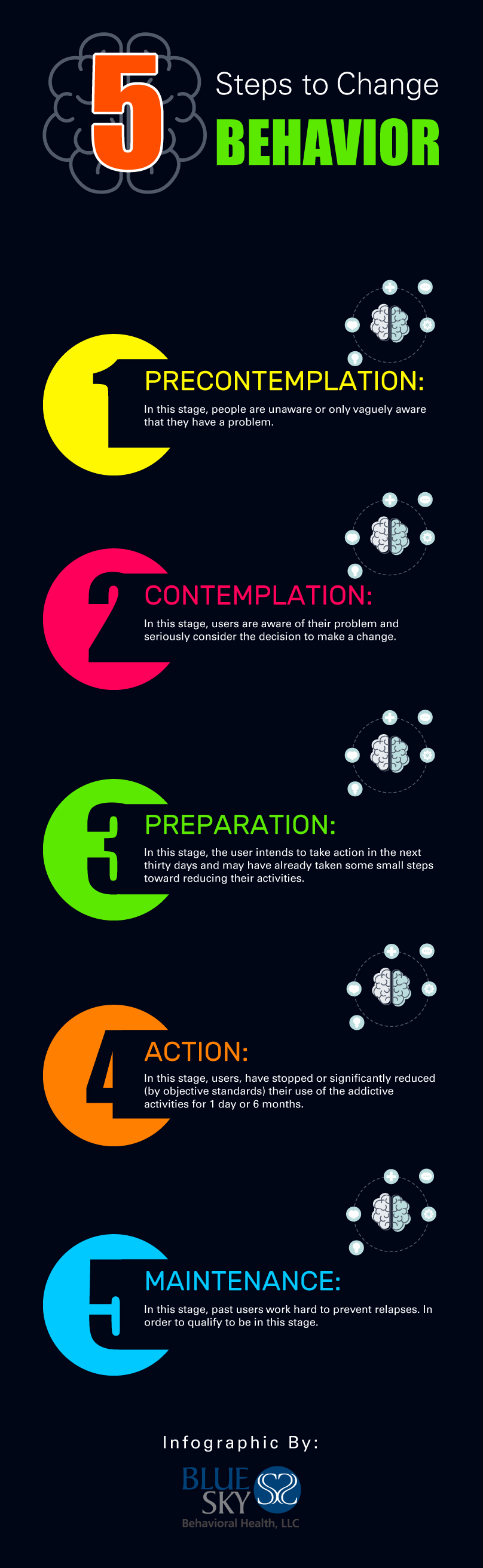
Why is it so hard to change a behaviour? What prevents us from eradicating a bad habit when we know the action is harmful to us? Behavioural psychologist James Prochaska breaks down the stages in which an addict is capable of enacting change into five categories; Precontemplation, Contemplation, Preparation, Action, and Maintenance. Determine where you or a loved one is in their journey of addictive behaviour change.
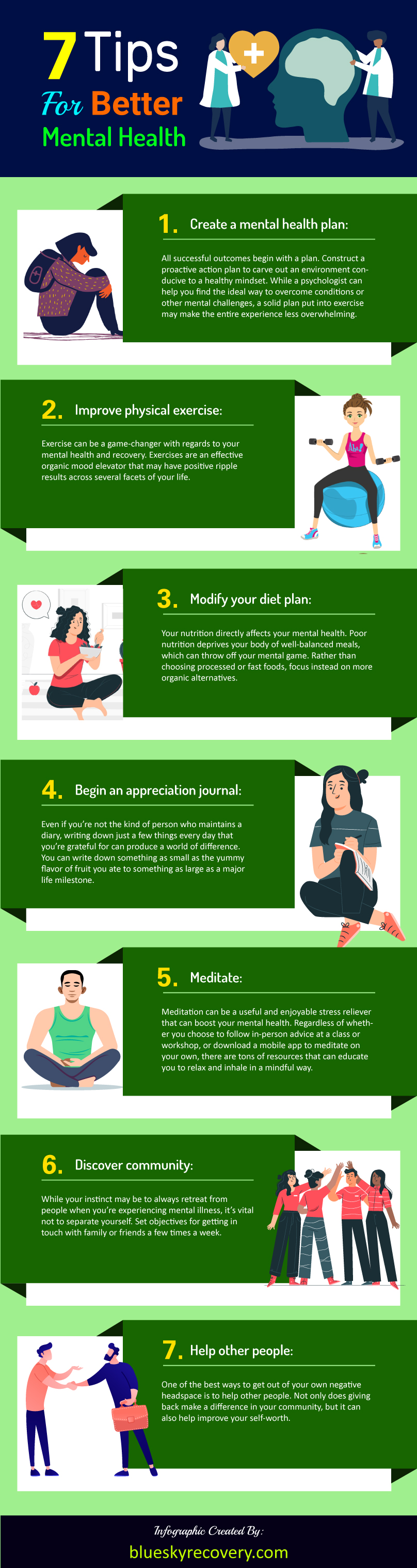
Prioritizing your mental health is one key to living a more fulfilling life. Apply these seven tips to actively improve your mental health and get more out of life.
Create a mental health plan: All successful outcomes begin with a plan. Construct a proactive action plan to carve out an environment conducive to a healthy mindset. While a psychologist can help you find the ideal way to overcome conditions or other mental challenges, a solid plan put into exercise may make the entire experience less overwhelming.
Improve physical exercise: Exercise can be a game-changer with regards to your mental health and recovery. Exercises are an effective organic mood elevator that may have positive ripple results across several facets of your life. Exercise can contribute to weight loss, muscle build-up, and boosted energy levels, which can aid in your emotional well-being. Be sure to pick a physical activity you appreciate doing, so you’re more inspired to keep up with it.
Modify your diet plan: Your nutrition directly affects your mental health. Poor nutrition deprives your body of well-balanced meals, which can throw off your mental game. Rather than choosing processed or fast foods, focus instead on more organic alternatives. Whole grains, fresh fruits, vegetables, fish, and nuts contribute to a healthier lifestyle and fuel your brain.
Begin an appreciation journal: Even if you’re not the kind of person who maintains a diary, writing down just a few things every day that you’re grateful for can produce a world of difference. You can write down something as small as the yummy flavor of a piece of fruit you ate to something as large as a major life milestone, such as obtaining a certain number of days of recovery or getting a new job. Over time, you may shock yourself at how many positive things take place in your life every day.
Meditate: No matter your spiritual or religious leaning, meditation can be a useful and enjoyable stress reliever that can boost your mental health. Regardless of whether you choose to follow in-person advice at a class or workshop, or download a mobile app to meditate on your own, there are tons of resources that can educate you to relax and inhale in a mindful way. By making an effort to remove distractions and focus on the present moment and your breath, you may be able to induce a state of internal calm and peacefulness.
Discover community: While your instinct may be to always retreat from people when you’re experiencing mental illness, it’s vital not to separate yourself. Set objectives for getting in touch with family or friends a few times a week. You can also participate in more formal meetings or meet-ups, such as a book club or team sport, to experience the advantages of social interaction. Connecting with loved ones and new peers can instill a sense of community, making you feel like you’re a part of something bigger (because you are!).
Help other people: One of the best ways to get out of your own negative headspace is to help other people. Not only does giving back make a difference in your community, but it can also help improve your self-worth. Select a task or organization that lines up with your interests and volunteer your time. The pleasure you’ll experience is worth the effort.
When to Look for Expert Help
If you need help determining whether or not you have a mental issue or want help moving past a present mental illness, BlueSky Behavioral Health is here to help you. Our expert team provides consultations, evaluations, guidance, and treatment for several mental health disorders, including Borderline Personality Disorder, Schizophrenia, Depression, and Anxiety.
Consider how a lack of support and guidance while growing up may have influenced development. Children growing up in dysfunctional homes seldom have access to the emotional support and guidance they need or want. Envision yourself at different key stages in your childhood. In a journal, write about emotional support or guidance you may have needed or wanted but did not obtain.
When you were a child, who was available for you? Who wasn’t available for you? Who nurtured you? Who failed to provide as much nurturance as you needed? How did you, as a child, adjust to any failure to receive adequate support or guidance?
What major life choices- right or wrong- do you think you made as a child as a direct result of such failures to obtain needed emotional support or guidance? Consider how a lack of support and guidance resources while growing up may still be influencing present-day behavior. The failure to receive needed emotional support and guidance in childhood has significant consequences in adolescence and adulthood.
In what ways do you think failures to receive needed emotional support and guidance in childhood may be influencing current behavior patterns? Provide a specific example by talking about something you did within the last week or so and then link it back to some event in your childhood. Think about how any lack of support and guidance during childhood will be overcome in the future.
The lack of this during childhood does not necessarily sentence an individual to unhappy adult life. In what ways have you been able to overcome or compensate for any lack of support or guidance during childhood? In what ways would you like to be able to overcome or compensate for any lack of support or guidance during childhood? What sources of support or guidance do you have in your life now? What additional sources of support or guidance might you have in your future?
What major life choices do you anticipate you will make in the near or long-term future? How do you intend to bring sound judgment to bear- and not past emotions- in making these choices?
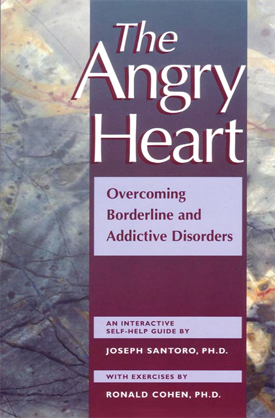
These recovery exercises are adapted from the book The Angry Heart written by Dr. Joseph Santoro and Dr. Ronald Cohen. Dr. Joseph Santoro is one of the founding members of Blue Sky Behavioral Health. Blue Sky offers individualized outpatient as well as residential treatment programs for mental health disorders such as borderline personality disorder. Our supportive and licensed clinical staff can make a major difference in your life. Learn how to live life well by contacting our facility today. Call (888) 822-7348 or visit us online at https://blueskyrecovery.com/
Focus on the concepts of psychological maturity and psychological immaturity. In this next exercise, you will be asked to consider what these terms mean, and how it can be applied to you personally. How would you define the term psychological maturity? How would you define the term psychological immaturity? What kind of home environment encourages each? What kind of fun or pleasures do you associate with each? Describe in as much detail as you can the nature of the psychological maturity you one day will reach.
The Origins of Anger
Anger can be thought of as a hostile response to a real or imagined threat. It may be expressed in passive ways, such as sulking in withdrawal or isolation. It may be expressed in extremely aggressive ways, as when one human being renders physical harm to another as a direct result of the arousal of this emotion. Ways of experiencing and expressing anger can be learned.
How and what did you learn about anger in your childhood? What effect, if any, has this childhood lesson had on the way you cope with or fail to cope with anger today? How do you deal with and tend to express anger? How would you like to be able to deal with and express anger?
Models- Caregivers and Other People
Understand how caregivers served as models for various kinds of adaptive as well as maladaptive behavior patterns. Children learn from the behavior of their caregivers or other caretakers. Sometimes what they learn can help them in life, but not always. Think about the ways in which you are behaving that very much the same way your caregivers use to behave. In what ways is it a good thing that you are following in their footsteps? In what ways is it a bad thing that you are following in their footsteps?
If you could choose anyone in the world to serve as a model for the way you would like to be, who would that person be? If that person doesn’t exist in real life, create an imaginary person to write about. What would that person look like? What would he or she value and believe in? What would this person think was fair and just? How would he or she treat others? How would he or she handle stress?
Psychological maturity and psychological immaturity go hand-in-hand, with each contributing to the other. Psychological maturity is hard to develop but may be discovered. Mental Health Center provides personality disorder treatment like conditions associated with emotional immaturity that deal with the destructive emotional and behavioral habits that cause Borderline Personality Disorder (BPD). If you or your family member wishes to beat addiction and learn more healthy ways to live, contact Mental Health Center Connecticut. They can help you.
Identifying the behavior(s) of the other person that is the direct trigger for your feelings. Identify how the other person is making you feel. Do not say, “You made me feel this way.” Say instead, “Your behavior made me feel this way.” Behavior can be changed, but no one can change who they are.
Identify what you would like the other person to do differently so you will feel better.
Tell the person this directly and without anger or aggressiveness. Use good eye contact and strong posture.
If the other person tries to argue with you, repeat your Three-Part Statement and refocus the discussion on the person’s behavior.
Here are a few samples, Three-Part Statements:
When you drink and we fight with each other (behavior), I feel very scared inside (my feelings). Could you seek help to stop drinking (action requested)?
When you use a sarcastic tone of voice with me (behavior), I feel like you are putting me down and then I feel angry (my feelings). Could you avoid using sarcasm when we talk (action request)?
When you criticize me in front of my friends (behavior), I feel embarrassed (my feelings). Could you speak to me in private when giving me criticism (action request)?
How Long Will It Take to learn?
Determination is more of an attitude than a skill. It needs constant cultivation. Determination is built on your inborn instinct for survival; the survival instinct is at its core. If you consistently cultivate an attitude of determination, the result that you achieve will amply reinforce your efforts. Hope feeds determination. Determination and hope working together produce success, which is what your recovery is all about.
How Is It Done?
Determination is essential to a successful recovery. In many respects, you have already demonstrated a great deal of determination. You have survived the psychodramatic event of your childhood. Even though your current lifestyle is painful, you are reading this article. These are signs of true determination. These are signs of someone who will never give up.
A serious mental health issue such as borderline personality disorder (BPD) requires mental health treatment by qualified professionals, there are also options for self-help for individuals with BPD. These self-help methods need to be used in addition to formal treatments for BPD (like psychotherapy and medicine).
When visualizing, you use your imagination to create a powerful motivating image in your mind’s eye. Imagination is an ability that everyone has, though few of us make full use of its enormous potential. Many people, instead, use their imaginations to think about all the horrible things that could happen. They catastrophize about what could go wrong and in doing so conjure all of the negative emotions that accompany the imaginary disasters.
Using visualization, you can harness the power of your imagination to guide yourself toward well-thought-out actions that keep you safe and improve the quality of your life.
Your objective is to visualize yourself engaged in positive action scenes in place of self-destructive, impulsive reactions to stressors. A well-visualized scene acts as a model for you to follow when working to modify your behavior. You can motivate yourself to match your behavior to the model created via visualization. Visualization will also help you confront your tendency toward negative thinking, which is one of the consequences of the distorted self-image conditioned by your psycho-traumatization. In fact, the main obstacle that you need to overcome in order to properly utilize visualization is your tendency towards negative thinking. Negative thinking says, “I can never learn this!” and “It won’t work anyway, it’s stupid!” Negative thinking has one purpose only: to keep you trapped in the Borderline Zone.
Practice Exercise 1: Observing Confusion
1. Go to a room where you have a TV, radio, and stereo. Put on a TV show, a station on the radio, and a tape or CD of your choice all at the same time. Set an alarm clock or a timer to go off in fifteen minutes.
2. Sit in the middle of all this confusion. Close your eyes and describe to yourself what is going on around you and how it is making you feel. Remember, just to sit there with your eyes closed and try to describe your feelings and the situation you just created. What impulses are coming to mind? Do not act on them, just observe and describe them as if you were a TV reporter,
3. Continue until the alarm goes off. After the exercise write your observations in a “current day” section of a journal. Repeat this exercise until you can do it for thirty minutes without acting on an impulse to the end the session before the alarm goes off.
Practice Exercise 2: Awareness without Emotion
1. Get a tape recorder and record some of your traumatic memories from your journal on a tape (if desired, you can erase the tape as soon as you have competed the exercise). Select passages that still evoke some feelings in you.
2. Play your tape through headphones with the volume on low. Put the TV on. Sit in a comfortable chair and start doing your SDB (Slow Deep Breathing) while repeating your key phrase. Ignore both the TV and the tape.
3. If you start to feel emotional stress, try to focus on the source of the emotions within your body. Is it centered in your stomach, neck, shoulder, head, brain, ect? Then, try to describe how it feels with neutral words. Remember, you are a TV reporter whose job is to describe the events being experienced. Identify the trigger for the feelings (was it something on your tape?). Become aware of any impulsive actions that come to mind. Remember, you are being objective, so you will not act on any of these impulses.
4. If the feelings or impulse are too overwhelming, STOP the exercise and get a soda or something to snack on to distract yourself. Otherwise continue the exercise until the tape is over and you feel satisfied with your performance. Your objective is to listen to the entire tape without allowing your emotions or impulses to reach an uncomfortable level. When you can do this you have successfully completed the exercise.
Basic Steps of Visualization
1. Close your eyes.
2. Begin your SDB (Slow Deep Breathing) routine while using your key phrase. Continue until your stress level drops below 4 on a scale of 1-10. 0 means totally calm and stress-free and 10 means totally stressed out.
3. Now imagine yourself executing a series of actions that produces a desirable outcome. Imagine as much detail as possible. See yourself doing the actions. See where you are. See who you are with. Hear the sounds. Smell the odors. See what you are wearing.
4. As negative thoughts enter your mind, squeeze your knees, say your key phrase, and return to your visualization.
5. Once you have imagined all of the details of you action sequence, assign it a “trigger word,” such as “Project Jump Start.” You will use this trigger word to get yourself started on executing the action sequence once the time comes.
6. Close your Visualization session with five repetitions of the positive affirmation “I want it; do it!”
Visualization will help you become a more consistent person. Do the practice exercises in the preceding and following Self-Help Skills to hone your Visualization skills. Practice makes better, but never perfect. Be aware that the exercise increases in psychological difficulty. This helps to strengthen you for the greater challenges ahead. Recovery doesn’t just happen, it is a learning process that is with you for the rest of your life.
Obtaining is the final ROVO Soothing skill. It means putting into action the plan that you visualized and getting the results you want. Obtaining means focused action that gets desired results. It requires a clear vision of what you want: a sound, thoughtful decision to act; and execution of your decision with determination.
Putting the Soothing Skills Together
1. Use Slow Deep Breathing and your key phrase to calm your emotions and impulses.
2. Use Objectifying to identify your stressors. Use it to describe the emotions and body locations of the emotions the stressors trigger. Use it to identify the action impulses the stressor trigger. Use it to describe the disruptive effects the stressors are having on your thought process. Use simple sentences and neutral words to Objectify what is happening to you.
These recovery exercises are adapted from the book The Angry Heart written by Dr. Joseph Santoro and Dr. Ronald Cohen. Dr. Joseph Santoro is one of the founding members of Blue Sky Behavioral Health. Blue Sky offers individualized outpatient as well as residential treatment programs for mental health disorders such as borderline personality disorder. Our supportive and licensed clinical staff can make a major difference in your life. Learn how to live life well by contacting our facility today. Call (888) 822-7348 or visit us online at https://blueskyrecovery.com/
Learning to relax your body and your thoughts is a wonderful skill to master. If you can do this, you will feel incredibly relaxed and safely remain on the SACRED road to recovery. There are many methods of relaxation that range from meditation to biofeedback. But the relaxation method that is probably the easiest to learn is Slow Deep Breathing (SDB)
Your objective is to develop the ability to calm your mind as soon as you feel your thoughts starting to race or as soon as you feel your anger starting to build. For the optimal results it is necessary that you practice SDB nearly every day for about fifteen to thirty minutes (five minutes is the minimum) until you can calm yourself on demand.
Self-Help Skill: Slow Deep Breathing (SDB)
Find a quiet place where you will not be interrupted for about fifteen minutes. Turn the phone off. Rate your stress level on a 1-to-10 scale where 0 means totally calm and stress-free and 10 means totally stressed out. Prepractice Relax Rating 0 1 2 3 4 5 6 7 8 9 10 Total Calm Total Stress
Sit in a comfortable chair with your feet flat on the floor. Place your hands palms down on or near your knees.
Close your eyes and listen to all of the sounds in your environment for a few moments. Try to focus your thoughts on what you hear. Ignore all other thoughts. If your thoughts wander, gently squeeze your knees and return your attention to a sound.
After a minute or two turn your attention to your breathing. Now, as slowly as you can, breathe in through your nose and count of 1, 2, 3, 4, 5, 6, 7, 8, 9, 10. Try to make your inhale last until you reach 10. Try to fill your lower abdominal area with air first, then your midsection, and finally your chest. Try to really expand your lung as much as possible. It may make you feel uncomfortable at first; this will be especially so if you smoke cigarettes or pot. However, with a little practice your ability to do expand your lungs will increase.
After you have fully inhaled, hold your breath for a count of 1, 2, 3.
Then exhale slowly to a count of 10, 9, 8, 7, 6, 5, 4, 3, 2, 1. As you exhale, think “I am calm” over and over again. Try to see these words light up in your mind as clearly as you can.
Repeat the SDB cycle for about ten to fifteen minutes or until you feel noticeably calmer. Concentrate on your breathing. Ignore all other thoughts. You will find it difficult to do this. But each time your thoughts drift, just squeeze your knees gently and refocus on “I am calm” and the rising and falling of your breathing. Once you get into a SDB rhythm, you can stop counting and just breathe.
After you feel calmer, open your eyes and rate your stress level again. How much calmer do you feel?
Remember to rate your stress levels pre- and postpractice. A rating, after practice, of 3 or less on the 0-to-10 relax scale is your goal.
Post-practice Relax Rating 0 1 2 3 4 5 6 7 8 9 10 Total Calm Total Stress
These recovery exercises are adapted from the book The Angry Heart written by Dr. Joseph Santoro and Dr. Ronald Cohen. Dr. Joseph Santoro is one of the founding members of Blue Sky Behavioral Health. Blue Sky offers individualized outpatient as well as residential treatment programs for mental health disorders such as borderline personality disorder. Our supportive and licensed clinical staff can make a major difference in your life. Learn how to live life well by contacting our facility today. Call (888) 822-7348 or visit us online at https://blueskyrecovery.com/